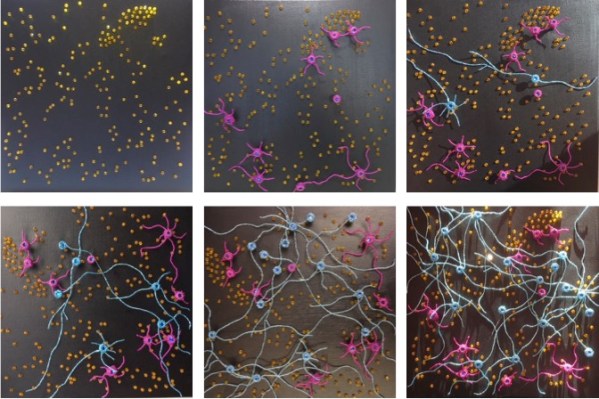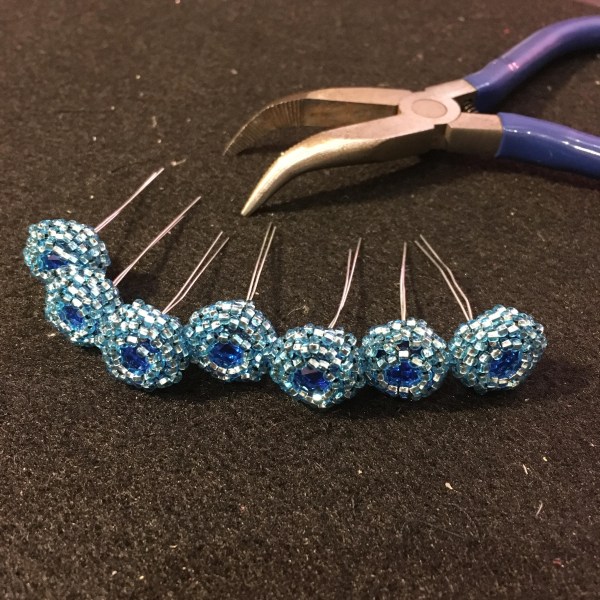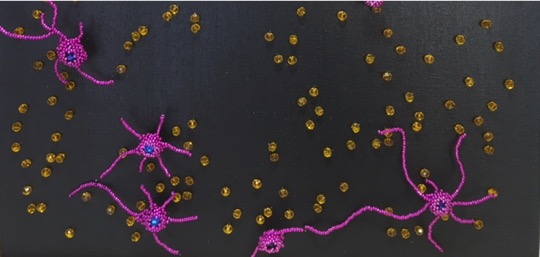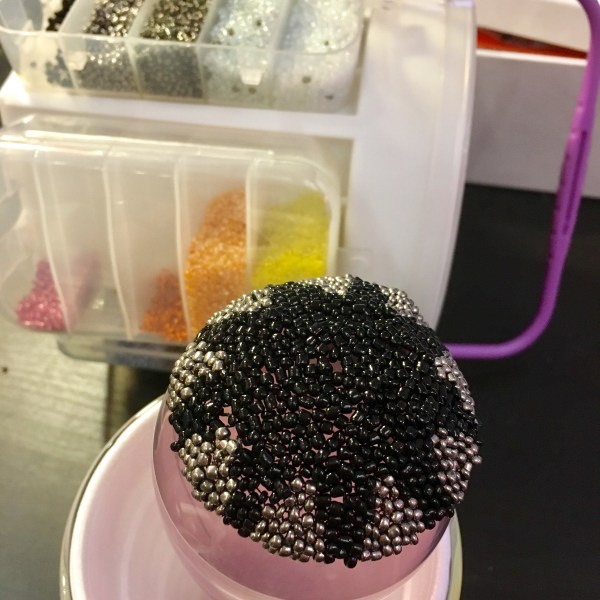
I am falling a little behind on posting these here, so I will put this blog post from the SciArt Residency program in quotes. Last week, Darcy, Kate and I had a very productive Skype call, where I expressed my concern about the technical challenges of attaching the beaded cells to the canvas in a... Continue Reading →
Creating art using the STEAM method
Last weekend, I mostly finished sewing the first layer of yellow rondelle beads. In the original microscopy image, the cell nuclei were colored bright blue, due to being labeled with Hoechst stain, which labels DNA. In Darcy’s version of the image, she switched this color to pale yellow, which makes them look more delicate and... Continue Reading →
The creative process
After settling on creating “Mapping Manhattan”, this week I finally got a chance to go out and buy some supplies, including a canvas and beads. I painted the canvas with black paint (though it ended up looking a bit like wood in the photo) to create the background that is typical for fluorescence microscopy images.... Continue Reading →
Why I am interested in cross-disciplinary collaboration
Now that I have joined the SciArt Center Bridge Residency program, I will be writing weekly blog posts about my progress in collaborating with Darcy Johnson. The posts will be published on the program website and I will be re-posting them here to continue using my blog for tracing the development of my art over... Continue Reading →
Learning some new beading techniques
While in between projects, I decided to learn some new beading techniques. I recently came across some amazing beadwork on Instagram by Julie Mars (@jamfinearts) and got inspired. I have a ton of multicolored beads that I don’t use for my main projects, so I decided to use them for learning how to bead around a... Continue Reading →
Trying a new approach in my art
Last year, I wrote about my negative view of a large percentage of abstract art (with some exceptions). My view of SciArt has always been that true scientific images/concepts should be accurately depicted (with some room for slight embellishment). While many people show the true natural beauty of scientific images, I also see a lot... Continue Reading →
Abstract art
I have never been a fan of abstract art. When I was about 10, my parents took me to Florida for the first time. While there, we took a day trip to St. Petersburg to visit the Salvador Dali museum. I felt lost and thought that the paintings were pointless. My parents said that it... Continue Reading →
Adrift
This single word describes my current state quite accurately. In the beginning of April, an unpredictable event knocked the ground out from under my feet. Due to unfortunate external circumstances, the place I loved working at had to drastically downsize its staff in order to stay afloat. As my daughter likes to sing "like a... Continue Reading →
Bridging science, art and society
Last year, when I founded NeuroBead, I based it on the idea that scientists like myself would want to see beautiful images from their research commemorated as pieces of art, that they could display on their walls. Many academic institutions, especially neuroscience departments, decorate their hallways with enlarged photos of cells that were taken under... Continue Reading →
“Branching Out” – the story of Sholl analysis
I have always been attracted to symmetry. Ever since childhood, symmetry and equilibrium have always put me at ease and gave me a sense of aesthetic satisfaction. In graduate school, I studied the process of differentiation (read "development") of nerve cells called neurons. Neurons have beautiful architecture, but are never actually symmetrical. Yet they still... Continue Reading →