Returning to my oasis
I have always said that art is my oasis – the place I go when I need to escape from stress, quiet my mind, and lose myself in something completely different.
And yet, over the past few months, I have severely neglected it.
Perhaps I felt that I needed to make the most of summer. There were trips, family plans, errands, and all the ordinary things that somehow multiply when the days are longer. My beadwork project sat unfinished while I found one reason after another not to return to it.
This week, though, presented almost perfect conditions for diving back in.
My husband is away on a business trip. It has been raining all day. And my daughter and I haven’t spoken to each other for the past five days.
Not exactly an idyllic week—but perhaps an ideal one for disappearing into art.
After spending the first half of the day at the gym, running errands, and getting the household ready for the week ahead, I was finally able to sit down and return to my abandoned project.
And immediately, I remembered one of the problems with taking a break from my art.
I have lost count of the number of projects where I developed specialized beadwork techniques, put the project aside for a while, and then returned to it only to discover that I could no longer remember exactly how I had done something.
A break of even a few weeks can apparently be enough to make me look at my own work and think: How did I do that?
I should really know better by now.
From cells to tissues
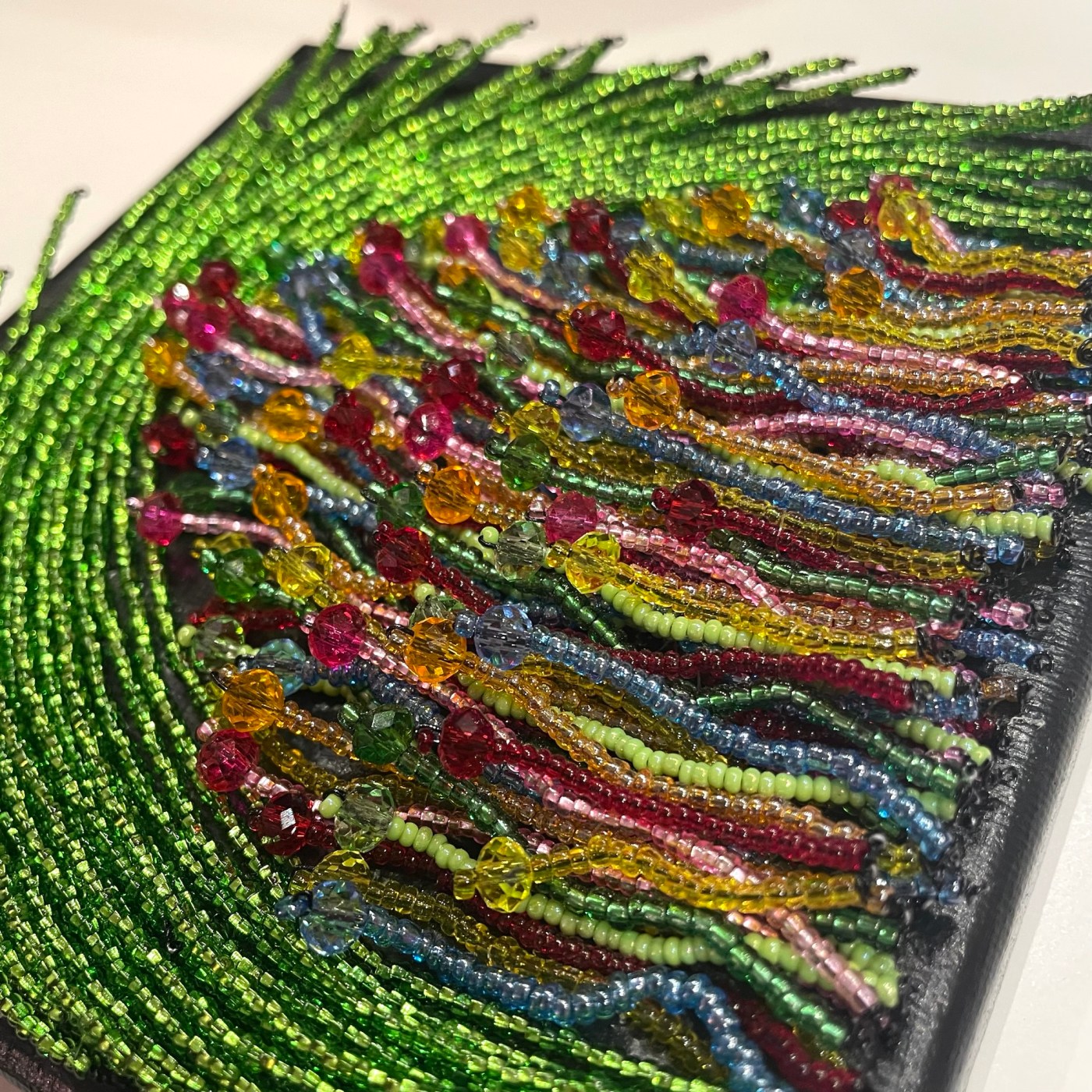
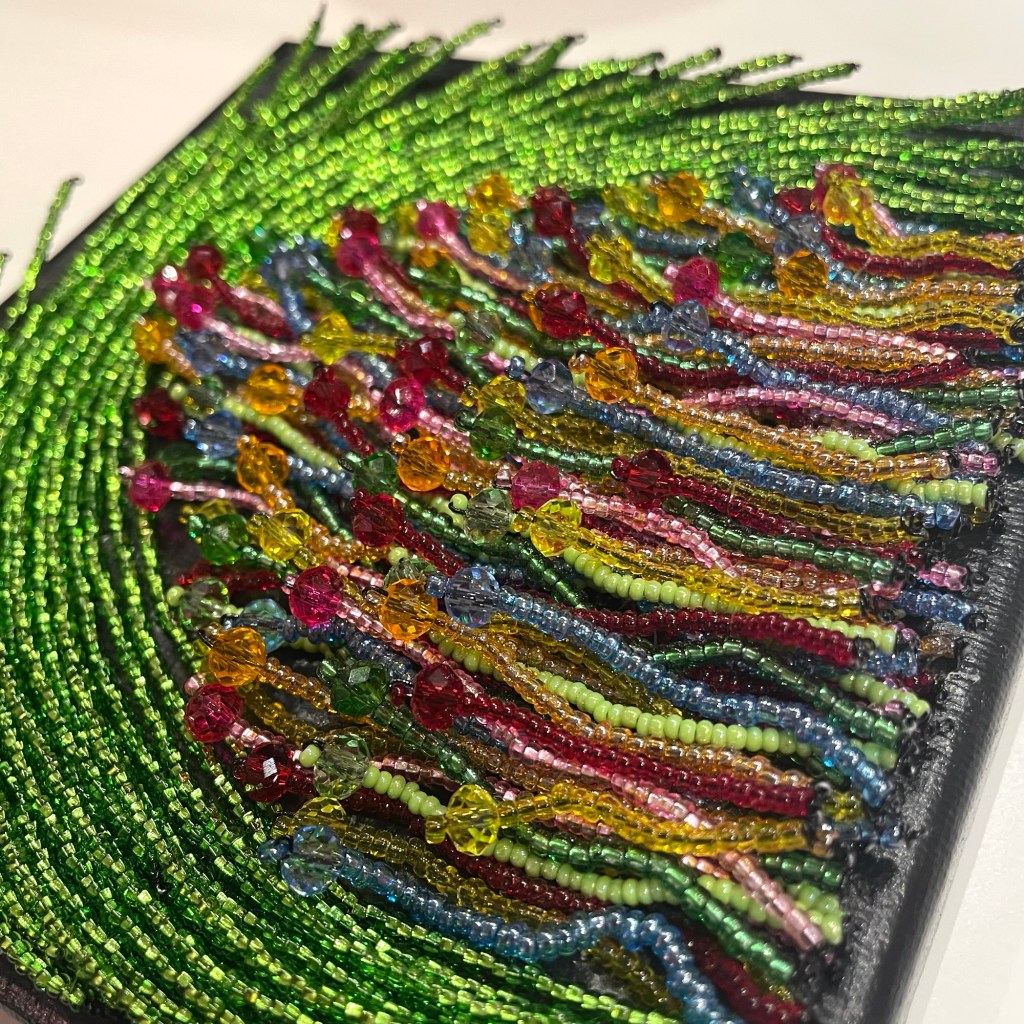
My most recent series of pieces has focused on tissues and organoids rather than individual cells cultured in vitro. This piece continues in that direction, but takes me into a very different part of the nervous system: the cerebellum.
The original image comes from a Brainbow mouse, in which different neurons are labeled with different fluorescent colors. The result is almost impossibly beautiful brain tissue that is transformed into an elaborate biological mosaic.
The particular image I used shows mossy fibers within the cerebellum:
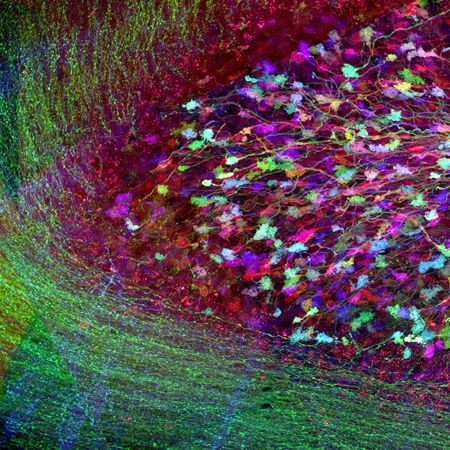
Mossy fibers, which are one major type of axon in the cerebellum, relay information from outside the cerebrellum. Here multicolored mossy fibers fan within the inner granular layer of one fold or “gyrus” of the cerebellum. The enlarged “splotches” of color represent presynaptic terminals, called mossy fiber rosettes. Around the edge of the gyrus, the parallel fibers course through the molecular layer where they synapse onto Purkinje cell dendrites (not visible).
As much as I value staying true to a scientific image, I occasionally take slight liberties in my renderings. This was one of those cases.
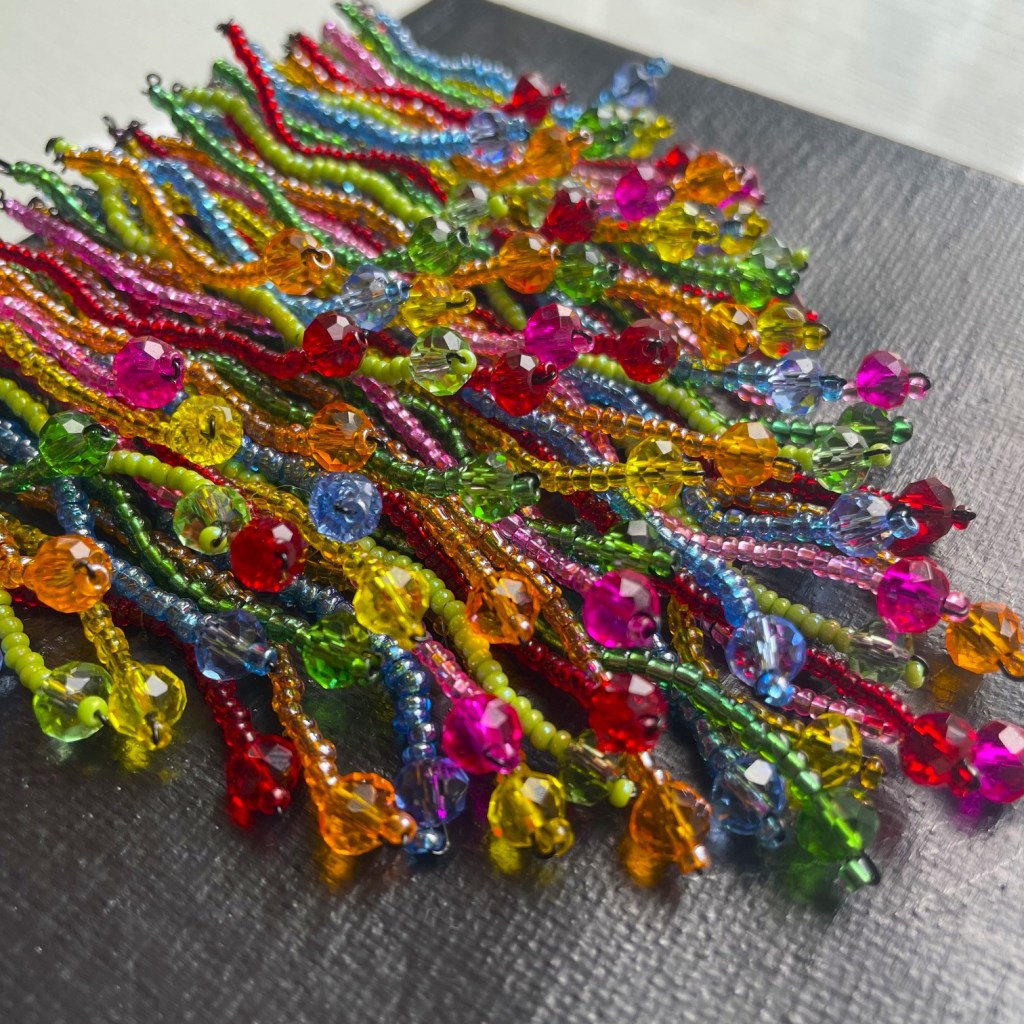
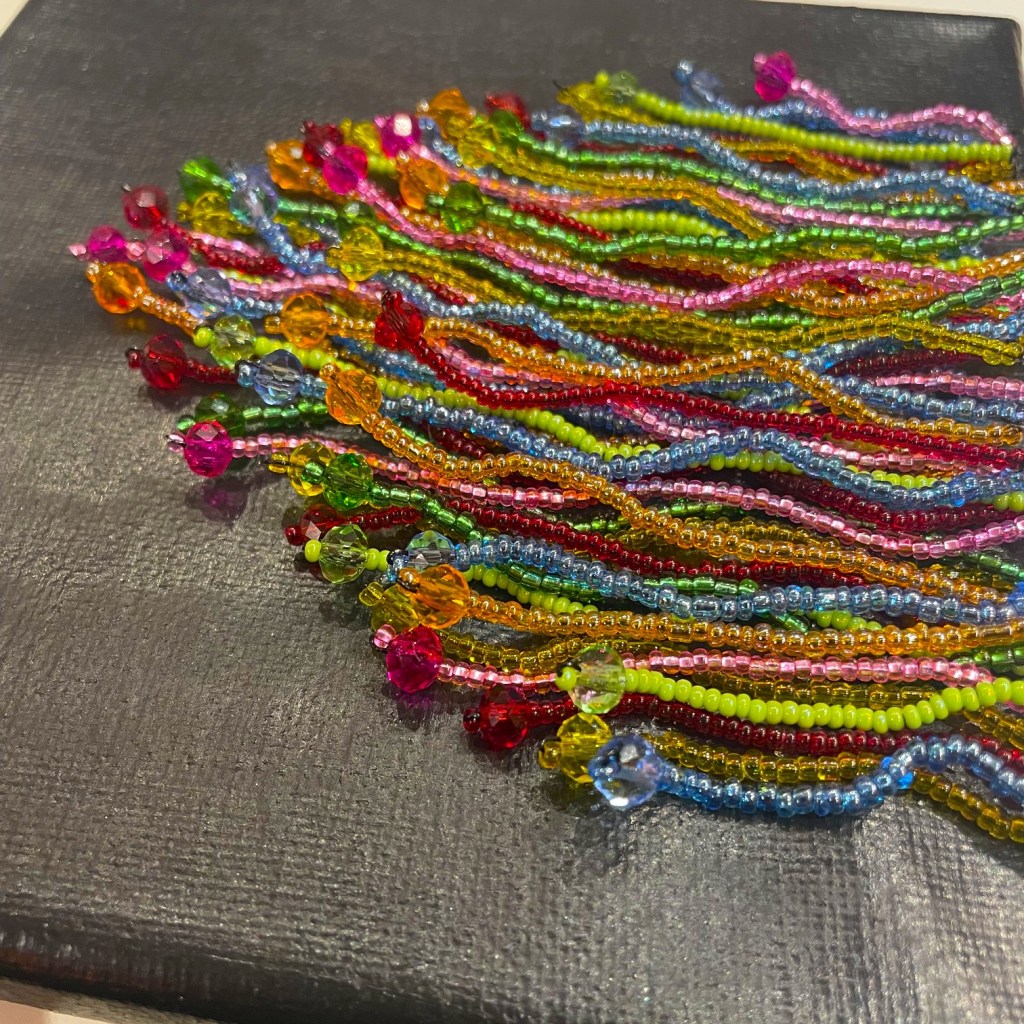
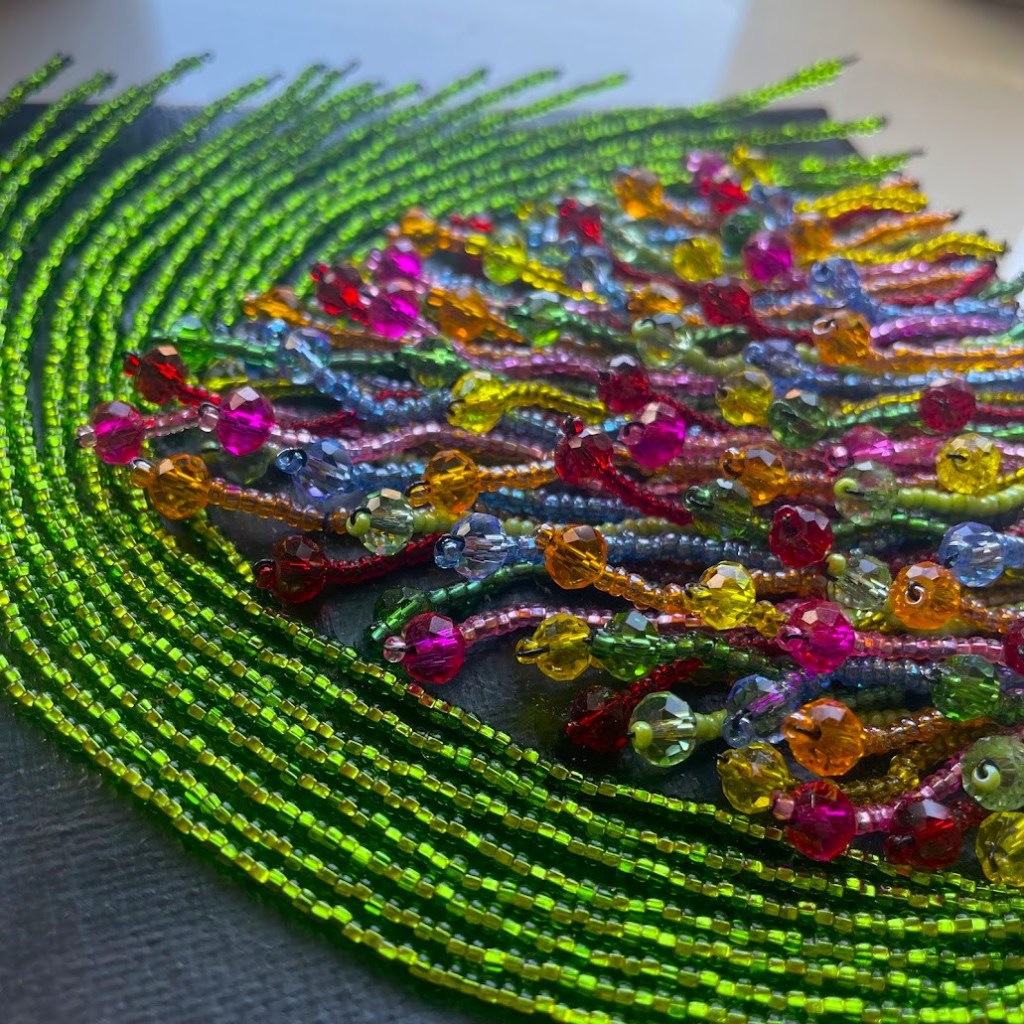
In the original microscopy image, the parallel fibers appear to course through the tissue in a relatively flat plane. For my beadwork, I imagined them in three dimensions instead. Some fibers protrude forward while others recede backward, creating depth that would not necessarily be visible in a confocal microscopy image.
In a sense, I was giving the image a dimension that the original photograph could only suggest.
A little bit of palimpsest
Like many of my other reliefs, this piece is constructed from multiple layers.
That brought me back to a project I worked on with Darcy Johnson in 2017, when we partially explored the concept of the palimpsest—something written, erased, and written over again, with traces of what came before still visible underneath.
I can’t erase layers of beadwork in quite the same way that words can be erased from a page. But I can build one layer over another, allowing parts of the lower layers to peek through.
The result is a kind of three-dimensional history: what is underneath never completely disappears.
Perhaps that is part of what I like about working this way.
Finding the white jewel
And then, almost at the very end, I realized that I had nearly forgotten something important.
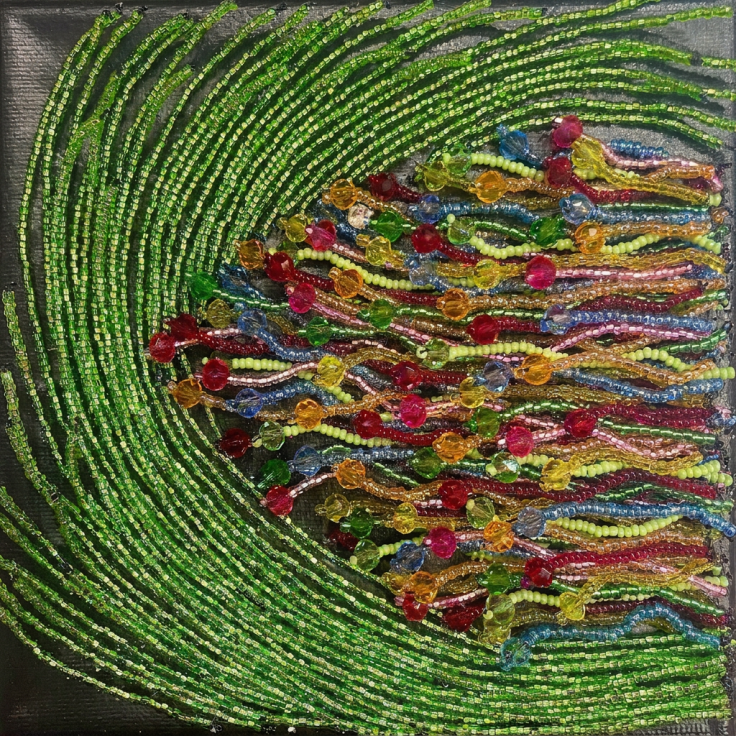
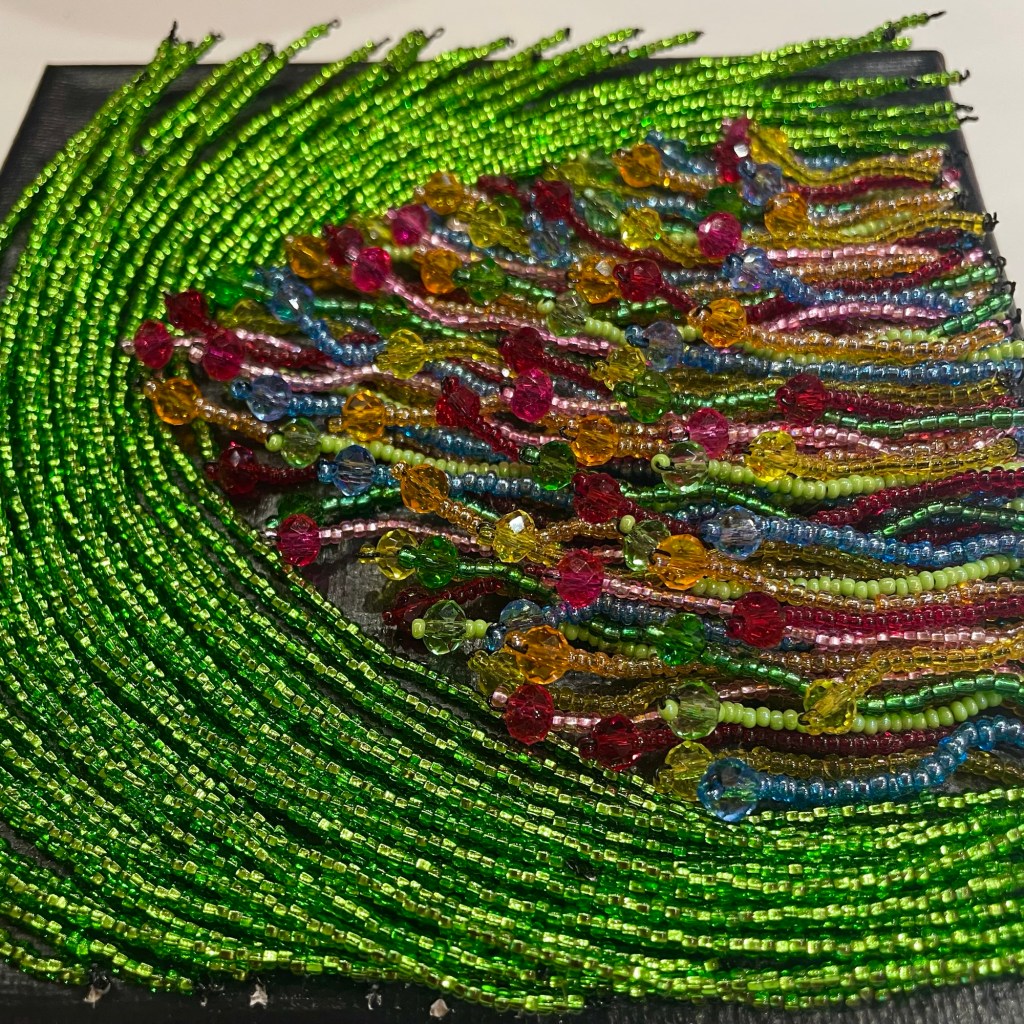
My signature white jewel.
Fortunately, I noticed in time and was able to add it before the piece was finished.
Can you find it in the photos below?
The white jewel originally came from my Hope series, where it represented a point of light or possibility within the scientific images I was interpreting.
Over time, though, it has taken on a different meaning for me.
Now, I think of it as representing a partially lost part of myself.
Being an artist has been a lifelong part of my identity, even during the many periods when I haven’t had much opportunity to practice it. I may go months (or sometimes years) without making much art, but that part of me doesn’t disappear completely.
It is still there, underneath everything else.
Much like one of those lower layers of beadwork, it can remain hidden for a while, waiting for something to bring it back into view.
And perhaps that is what happened this week.
I sat down to finish a piece that I had abandoned months ago, and somewhere along the way, I found my way back to my oasis.


Leave a comment